The Pros and Cons of AI in School: A Complete Student's Guide
The Pros and Cons of AI in School: A Complete Student's Guide
Artificial intelligence has burst onto the educational scene with tools like ChatGPT, Google Gemini, and countless AI-powered learning platforms. Whether you're a high school student facing homework challenges or a college student managing complex research projects, AI tools are increasingly becoming part of the academic landscape. But this technological revolution raises critical questions: Is AI a powerful ally for learning, or does it risk undermining the very skills education aims to develop?
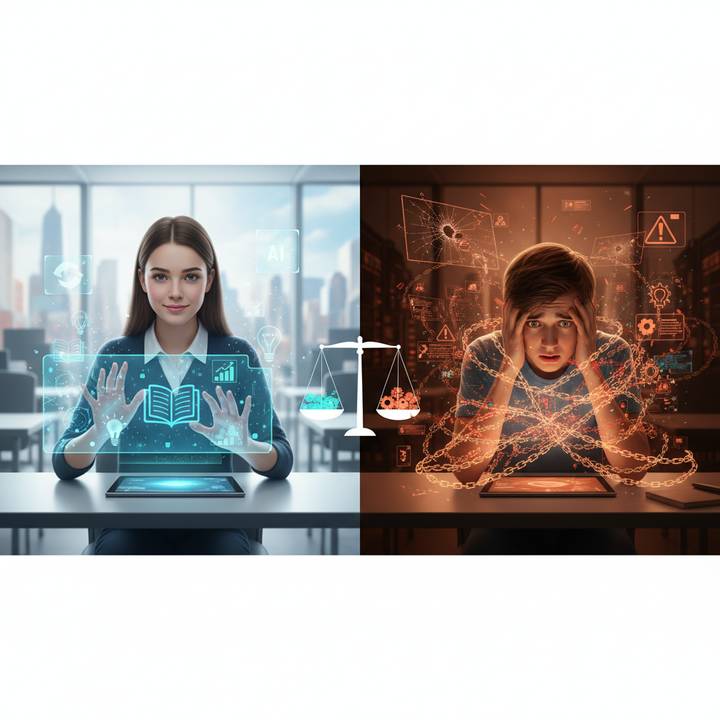
The truth is nuanced. AI in education is neither entirely good nor entirely bad—it's a powerful tool that can revolutionize learning when used responsibly, but presents significant risks when misused. This comprehensive guide explores both sides of the equation, helping you understand how to harness AI's benefits while avoiding its pitfalls.
| Pros of AI for Students | Cons of AI for Students |
|---|---|
| Personalized learning paths | Over-reliance and reduced critical thinking |
| 24/7 tutoring and homework help | Plagiarism and academic dishonesty |
| Enhanced research capabilities | Inaccuracy and AI "hallucinations" |
| Improved writing and language skills | Loss of originality and creativity |
| Automation of tedious tasks | Data privacy concerns |
| Greater accessibility for all learners | The digital divide |
| Development of future-ready skills | Potential for algorithmic bias |
The Benefits: 7 Ways AI Can Help Students (Pros)
When used appropriately, artificial intelligence offers remarkable advantages for student learning. These tools can democratize education, provide personalized support, and free up time for deeper thinking and creativity.
1. Personalized Learning Paths
One of AI's most powerful capabilities is its ability to adapt to your individual learning style, pace, and current knowledge level. Unlike traditional one-size-fits-all classroom instruction, AI-powered learning platforms can identify your strengths and weaknesses, then adjust content difficulty accordingly.
Example: Adaptive learning platforms like Khan Academy's Khanmigo or DreamBox adjust question difficulty based on your answers. If you're struggling with quadratic equations, the system provides additional practice problems and alternative explanations. If you're excelling, it accelerates to more challenging material, keeping you engaged without boredom.
2. 24/7 Access to Tutoring and Homework Help
AI eliminates the constraints of time and location when you need academic support. Whether it's 11 PM and you're stuck on a chemistry problem or you're working on a weekend when teachers aren't available, AI tools provide instant assistance.
Example: You can ask ChatGPT to explain the difference between mitosis and meiosis using a simple analogy, or use Khanmigo to get step-by-step hints on solving a calculus problem without revealing the complete answer. This constant availability reduces frustration and keeps learning momentum going.
3. Enhanced Research and Information Gathering
AI-powered search and summarization tools can dramatically speed up the research process. Rather than wading through dozens of articles, AI can synthesize information from multiple sources, identify key themes, and present you with relevant findings along with proper citations.
Example: Tools like Perplexity AI or Google Gemini can answer complex research questions with synthesized responses and cite their sources. If you're researching the causes of the French Revolution, AI can provide a comprehensive overview in minutes, complete with links to primary and secondary sources for deeper investigation.
4. Improved Writing and Language Skills
AI writing assistants provide real-time feedback on grammar, style, clarity, and tone—essentially offering a writing coach available at all times. This immediate feedback loop helps you learn from mistakes and develop stronger writing skills over time.
Example: Grammarly's AI-powered suggestions go beyond basic spell-check to identify passive voice, unclear phrasing, and tone inconsistencies. For English language learners, tools can explain grammar rules in your native language and suggest more natural phrasing in English.
5. Automation of Tedious Tasks
AI can handle time-consuming administrative tasks that don't directly contribute to learning, freeing you to focus on higher-level thinking and creativity. This includes everything from generating flashcards to formatting citations to organizing study schedules.
Example: Tools like Quizlet now use AI to automatically generate flashcards from your notes or textbook photos. Citation generators can create perfectly formatted bibliographies in MLA, APA, or Chicago style in seconds. This automation reduces busywork and leaves more energy for actual studying.
6. Accessibility for All Students
AI technology is breaking down barriers for students with disabilities or learning differences, making education more inclusive. From visual to auditory to cognitive challenges, AI provides accommodations that were previously unavailable or expensive.
Example: Text-to-speech tools help students with dyslexia or visual impairments access written content. Speech-to-text enables students with motor difficulties to complete written assignments. Real-time translation tools help non-native speakers follow along in class. AI-powered note-taking apps like Otter.ai can transcribe lectures for students who struggle with processing speed.
7. Fostering Future-Ready Skills
Learning to use AI effectively is increasingly recognized as a critical skill for the modern workforce. By incorporating AI tools into your education now, you're developing technological literacy and learning to collaborate with artificial intelligence—capabilities that will be valuable in virtually every career field.
Understanding how to prompt AI systems, evaluate their outputs, and integrate AI assistance into workflows are becoming as fundamental as knowing how to use a word processor or spreadsheet. Students who develop these skills early will have a significant advantage in the job market.
The Drawbacks: 7 Major Risks of AI for Students (Cons)
Despite its benefits, AI in education comes with significant risks that can undermine learning, academic integrity, and the development of critical skills. Understanding these drawbacks is essential for responsible use.
1. Risk of Over-Reliance and Reduced Critical Thinking
Perhaps the most serious concern is that easy access to AI-generated answers can create a temptation to bypass the thinking process entirely. When you can get an instant answer to any question, the mental effort required to wrestle with difficult concepts—the very struggle that builds deep understanding—can be avoided.
Over-reliance on AI prevents you from developing problem-solving skills, resilience when facing challenges, and the ability to think independently. Students who consistently use AI as a shortcut rather than a learning aid may find themselves unprepared when they face situations where AI isn't available, such as exams or real-world problems requiring original thought.
Real-world consequence: A student who uses AI to solve all their physics homework problems without working through the steps themselves may pass assignments but fail badly on in-class tests, revealing they never actually learned the material.
2. Plagiarism and Academic Dishonesty
The ease with which AI can generate essays, reports, and answers creates unprecedented opportunities for academic dishonesty. Submitting AI-generated work as your own violates academic integrity policies at virtually every educational institution and can result in serious consequences including failing grades, disciplinary action, or even expulsion.
Moreover, AI detection tools like Turnitin's AI Writing Detection and GPTZero are becoming increasingly sophisticated at identifying AI-generated text. Many instructors are also developing the ability to recognize AI writing patterns, making cheating increasingly risky.
Important note: Even if AI detection tools aren't perfect, academic dishonesty remains wrong. The purpose of education isn't just to get credentials—it's to develop knowledge and skills you'll need throughout life.
3. Inaccuracy and "Hallucinations"
AI models can generate confident-sounding information that is partially or completely incorrect—a phenomenon known as "hallucination." These systems don't actually understand facts; they predict likely word sequences based on training data, which means they can fabricate citations, misstate historical facts, or provide flawed explanations.
This is particularly dangerous because AI presents false information with the same confidence as accurate information, making it difficult to distinguish truth from fiction without verification. Relying on AI without fact-checking can lead to learning misinformation or submitting work containing serious errors.
Example: ChatGPT might confidently cite a scientific study that doesn't exist or provide a date for a historical event that's off by decades. Students who don't verify this information might incorporate these errors into their work, undermining its credibility.
4. Lack of Originality and Creativity
AI-generated content tends toward the generic and formulaic. These systems work by identifying patterns in existing content and reproducing similar structures, which means they inherently lack true originality, personal voice, and creative insight—the very qualities that make writing and thinking distinctive and valuable.
When students rely heavily on AI, their work begins to sound like everyone else's: competent but bland, technically correct but lacking personality and original thought. This homogenization of student work not only makes academic dishonesty more obvious but also prevents the development of a unique intellectual voice.
Additionally, the creative struggle of finding the right words, making unexpected connections, and developing original arguments is valuable in itself. Outsourcing this process to AI means missing out on developing creativity and intellectual confidence.
5. Data Privacy and Security Concerns
When you enter information into AI tools, you're potentially sharing personal or sensitive data with companies whose data handling practices may not be transparent or secure. Many free AI services use your inputs to train future models, meaning your homework questions, essay drafts, or personal information could become part of the system's training data.
For students under 13, there are additional legal protections (COPPA regulations) that many AI services don't adequately address. Even for older students, sharing school assignments or personal information raises concerns about privacy, data breaches, and unauthorized use of your intellectual work.
Consideration: Before using any AI tool, check its privacy policy. Be especially cautious about entering personally identifiable information, and never share sensitive data like passwords, social security numbers, or private family information.
6. The Digital Divide
Not all students have equal access to AI tools, devices, or reliable internet connections. While some advanced AI platforms are free, others require subscriptions. Some families can afford premium versions with better features, while others struggle with access to basic technology.
This unequal access can widen existing achievement gaps, creating advantages for students from affluent backgrounds while leaving behind those from under-resourced communities. The digital divide threatens to turn AI from an equalizing force into another mechanism of educational inequality.
Schools themselves vary dramatically in their technology infrastructure and policies, meaning students in well-funded districts may have very different AI learning experiences compared to students in under-resourced schools.
7. Potential for Bias
AI models are trained on existing internet content, which reflects historical and ongoing societal biases related to race, gender, religion, and other characteristics. These systems can perpetuate stereotypes, provide culturally insensitive responses, or present a limited worldview that doesn't represent diverse perspectives.
For students using AI for research or writing about topics involving social issues, history, or culture, this bias can lead to skewed understanding or the reinforcement of harmful stereotypes. AI may also perform better in English than in other languages, disadvantaging non-English speakers.
Example: An AI system might provide career suggestions based on gender stereotypes or present a Eurocentric view of historical events without acknowledging multiple perspectives. Students need to critically evaluate AI outputs for potential bias rather than accepting them uncritically.
Striking the Right Balance: How to Use AI in School Ethically & Effectively
The goal isn't to avoid AI entirely—that would be unrealistic and would deprive you of valuable tools. Instead, the key is learning to use AI responsibly as a learning aid rather than a replacement for learning. Here are practical strategies for ethical and effective AI use:
Understand Your School's Policy
Before using any AI tool for schoolwork, carefully review your school's academic integrity policy and AI-specific guidelines. Policies vary widely—some schools ban AI use entirely, others allow it with proper citation, and still others encourage it for certain tasks but not others.
Don't assume what's acceptable. If policies are unclear, ask your teacher directly. Clarifying expectations upfront prevents misunderstandings and potential academic consequences later.
Use AI as a Starting Point, Not an End Point
AI is most valuable when it helps you begin the learning process, not when it completes it for you. Use AI for brainstorming ideas, generating outlines, understanding difficult concepts, or getting feedback on drafts—but always do your own thinking, writing, and refining.
Practical approach: If you're writing an essay, you might ask AI to suggest thesis statement ideas or outline structures, but write every sentence yourself. For math problems, use AI to check your work or understand where you went wrong, but solve problems independently first.
Always Fact-Check AI-Generated Information
Treat any information from AI as a starting hypothesis that requires verification. Cross-reference AI outputs with authoritative sources like academic journals, established educational websites, or primary documents. This practice not only prevents errors but also develops your research and evaluation skills.
Look for information from multiple credible sources. If AI provides a citation, verify that the source exists and actually says what the AI claims. Don't let AI's confident tone substitute for actual accuracy.
Cite Your Sources (Including AI)
If you use AI in any substantive way during your research or writing process, be transparent about it. Many style guides now include formats for citing AI assistance. Being upfront about your use of AI demonstrates integrity and helps your teachers understand your work process.
Different uses require different levels of citation. If you simply used AI to check grammar, that might not require citation. If AI helped you understand a concept that you then wrote about, mention it in an acknowledgment. If you included any AI-generated text (even with modifications), that absolutely requires citation.
Focus on Learning the Process
The ultimate purpose of education is developing your thinking skills, not just getting correct answers. When using AI, always ask yourself: "Am I learning from this interaction, or am I just getting an answer?"
Use AI to understand how to approach problems, not just what the solution is. Ask AI to explain its reasoning. Try solving similar problems on your own afterward to confirm you've actually learned the underlying concepts.
Better practice: Instead of asking AI "What's the answer to problem 5?", ask "What strategy should I use to approach this type of problem?" or "Can you explain why this formula applies here?" This shifts AI from answer-provider to learning coach.
Frequently Asked Questions (FAQ)
Is AI good or bad for school?
AI is neither inherently good nor bad—its value depends entirely on how it's used. When used as a learning aid to enhance understanding, provide personalized support, and develop critical thinking skills, AI can be extraordinarily beneficial. When used as a shortcut to avoid learning or as a tool for academic dishonesty, it's harmful. The technology itself is neutral; the outcomes depend on the choices students and educators make about implementation.
Can teachers detect if you use AI?
Yes, increasingly so. Teachers have multiple methods for detecting AI use: specialized detection software like Turnitin's AI Writing Detection and GPTZero; recognition of AI's characteristic writing patterns (formulaic structure, overly formal tone, generic examples); inconsistencies between a student's usual writing style and submitted work; and simply asking students questions about their work process. Detection tools aren't perfect, but they're improving rapidly. More importantly, teachers are becoming skilled at recognizing AI-generated content through experience. The risk of getting caught using AI dishonestly is significant and growing.
What is the biggest disadvantage of AI for students?
The most significant disadvantage is the risk of over-reliance leading to reduced critical thinking skills. When students consistently use AI to bypass the challenging mental work of problem-solving, analysis, and creative thinking, they fail to develop the cognitive abilities that education aims to foster. This creates a superficial understanding that may help pass classes but leaves students unprepared for real-world situations requiring independent thought, complex reasoning, and original problem-solving—skills that are essential for career success and informed citizenship.
What are some examples of AI tools students can use?
Students have access to numerous AI tools across different functions:
- General AI assistants: ChatGPT, Google Gemini, Claude
- Educational platforms: Khan Academy's Khanmigo, Duolingo (for language learning)
- Writing assistance: Grammarly, QuillBot, Hemingway Editor
- Research tools: Perplexity AI, Consensus (for academic research)
- Study aids: Quizlet (AI-generated flashcards), Otter.ai (lecture transcription)
- Math help: Photomath, Microsoft Math Solver
Always check your school's policy before using these tools for coursework, as acceptable tools and uses vary by institution.
Looking Forward: AI and the Future of Education
As AI technology continues to evolve, its role in education will undoubtedly expand. Rather than resisting this change, the educational community is increasingly focused on teaching students to use AI wisely—treating it as a tool to augment human intelligence rather than replace it.
Future skills will likely include AI literacy: understanding how these systems work, recognizing their limitations, prompting them effectively, and evaluating their outputs critically. Students who develop these competencies now will be well-positioned for a workforce where human-AI collaboration is standard.
The most successful students will be those who use AI to enhance their learning without becoming dependent on it—who leverage technology to handle routine tasks while reserving their mental energy for creative thinking, complex problem-solving, and original work that AI cannot replicate.
Conclusion: The Power—and Responsibility—of AI in Your Education
Artificial intelligence represents both tremendous opportunity and significant risk in education. It can personalize learning, provide 24/7 support, enhance research capabilities, and prepare you for a tech-integrated future. Yet it also threatens to undermine critical thinking, enable academic dishonesty, perpetuate inaccuracies, and widen existing inequalities.
The key is approaching AI with intentionality. Ask yourself: "Will using AI in this situation help me learn, or help me avoid learning?" Use it to understand concepts better, work more efficiently on routine tasks, and develop tech skills—but never as a replacement for your own thinking, writing, and problem-solving.
Your education is ultimately about developing yourself as a thinker, creator, and problem-solver. AI is a powerful tool in that development, but only if you remain in charge of your learning journey. The goal isn't to ban AI from education—that's neither realistic nor beneficial. The goal is to learn how to integrate it thoughtfully, ethically, and effectively into your academic life, ensuring that technology enhances rather than diminishes your education.
By understanding both the benefits and drawbacks of AI, and by committing to responsible use, you can harness this technology's power while avoiding its pitfalls—preparing yourself not just for academic success, but for informed, ethical participation in an increasingly AI-integrated world.